Saturday, May 30, 2026

Autocracy and the International Order: How Trump's Disastrous Iran War Demonstrates the Dangers of the "Great Leader" Approach to Foreign Affairs

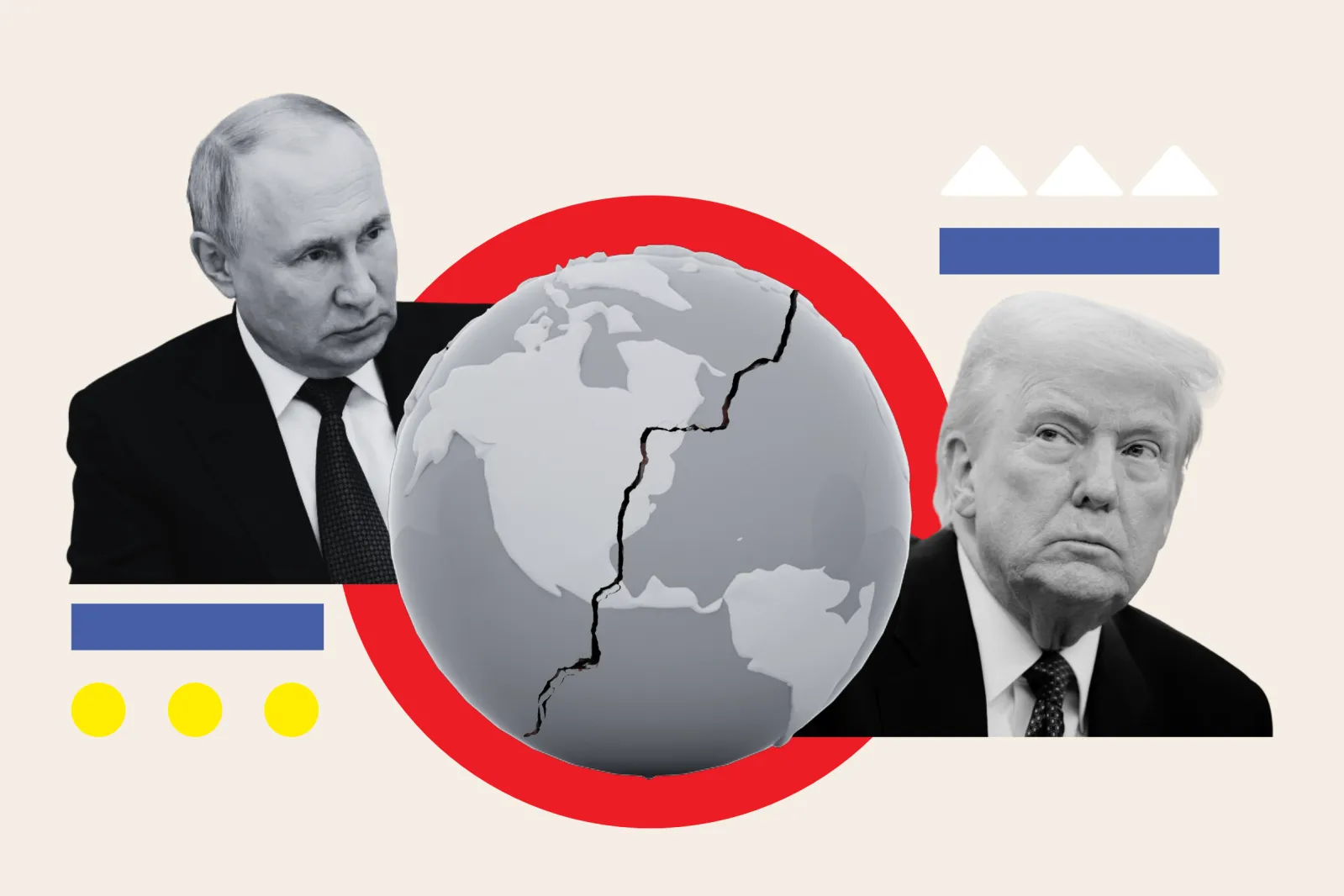
Map Shows How Trump, Putin Could CarveBy all accounts, the Iran War is a colossal failure. Neither Trump nor his aides can articulate an effective endgame to the conflict or one that doesn't look like an American defeat. Was the war's failure simply a lack of planning and developing effective scenarios for a successful outcome and the day after? Or are there deeper reasons for its failure which need to considered beyond those for which Trump has already been criticized?

The larger issue is Trump's underlying view of the world order. In his vision, there should be a  tripartite division of the world in which 3 leaders, Trump, Vladimir Putin and Xi Jinping, possess absolute control all major decisions which affect the respective areas of influence. Two of these leaders are already institutionalized autocrats. Trump is working hard to undermine American democracy assure that he becomes an autocrat too. Once he achieves this goal, he will be able to act unconstrained manner in global affairs, unencumbered by any form of checks and balance and the rule of law. Map Shows How Trump, Putin and Xi Could Carve Up the Globe

The Iran War should thus be seen a product of the Great Leader Theory of governance.  So-called "Great Leaders" inevitably make decisions which come back to bite them (think, for example, about Napoleon and Hitler's invasion of Russia). Believing they are the font of wisdom, whether in domestic or in foreign affairs, these "Great Leaders" eschew advisors. As Trump said in a January 2026 interview with The New York Times, he follows his intuition in decision-making and only "answers to himself." The Iran War is a perfect example of how this model of rule can produce a global disaster.The Trump Interview: A President Who Answers Only to Himself

To understand Trump's model of autocracy, we first need to examine his vision of foreign affairs. As Stephen Miller, his top ideologue, forcibly argued in an interview with CNN's Jake Tapper, the Trump regime's core proposition is that the world runs on force, not normative precepts. Only those nations which possess overwhelming military and economic power can and should occupy preeminent positions in the international system. Stephen Miller 's interview with Jake Tapper

Second, Trump views the world functioning according to the whims and fancies of the leaders of its three most powerful countries: the United States, Russia and China. International institutions, and the treaties they engender, not only lack power but are meaningless fig leafs designed to mask the real dynamics of the global order. It is Trump, Putin and Xi Jinping, not international institutions, treaties and alliances, who "make the world go round."

Third, Trump's decision-making is grounded in transactional behavior. In the international system, each leader seeks to gain what is best for his (not her as yet) country, devoid of the international norms of the post-WWII rules based order.  Trump makes "deals," not agreements, as his references to the Iran War make clear. There is not long-term strategy because political decision-making is moving from one deal to the next, much in keeping with a the myriad real estate transactions which defined Trump's pre-political life.

Finally, Trump rejects the Western alliance. Instead he views the world as carved up into three spheres of influence.  The United States controls North and South America, Putin controls Europe and Xi controls much of East Asia. This view of the world explains why Trump has failed to support Ukraine in its war with Russia and, more recently, has shown lukewarm support for Taiwan (even though the latter is home to TSMC, the world's most important producer of semiconductors).

The Iran War and Other Trump Fantasies Following in the footsteps of Vladimir Putin's equally disastrous 2022 invasion of Ukraine (deemed by Russian forces to last no more than 48 hours before Ukraine capitulated), so too was Trump's decision to attack Iran with Israel based on a set of faulty assumptions. The belief that decapitating Iran's leadership and the use of overpowering force would lead to Iran's immediate surrender proved to be the most fallacious one. 

Only recently did the world learn, through excellent investigative reporting by The New York Times, that Trump and Netanyahu sought to install former Iranian president, Mahmoud Ahmadinejad, as ruler once Iran surrendered.  In effect, Ahmadinejad would become Iran's  Delcey Rodriguez. A core but faulty assumption was that the attack on Iran would lead to the same outcome as Venezuela. 

No matter that Ahmadinejad was virulently anti-Israel and a despotic leader when in power as Iran's president. After Ahmadinejad stole the 2009 presidential election, widespread demonstrations broke out which he brutally suppressed. But as long as he cooperated with the Trump, like Rodriguez in Venezuela, he would be America's man in Tehran. Early War Goal Was to Install Hard-Line Former President as Iran’s Leader

The focus on the Great Leader Theory of rule suffers from a large dose of narcissism. Putin's invasion of Ukraine is part of his project to create a Eurasian Empire stretching from Europe through Central Asia with Russia at its core. Xi's forcing all Chinese school children to learn his political creed, Xi Jinping Thought on Socialism with Chinese Characteristics for a New Era, reminds of Mao's Red Book which likewise had to be memorized.  All three leaders view themselves as the center of the universe.

Trump's deeply flawed worldview is evident from the ongoing war in Ukraine. In the now infamous White House meeting with Ukraine's president, Volodymyr Zelensky, on February 28, 2025, Trump mocked Zelensky for "not having any cards in his hand." Trump and J.D. Vance accused Zelensky of being foolish for not ending the war on Putin's terms, namely giving up significant Ukrainian territory, including some which Russian forces had not yet seized. Trump and Zelenskiy clash, leaving Ukraine exposed in war with Russia

If Trump had be able to shed his "Putin envy," namely his desire to be an autocrat like his Russian counterpart, for a structural-strategic view of the war, he would have discovered that Ukraine was in the global forefront of drone technology. While Russia's population is 3 times that of Ukraine and it has a much larger army, Ukrainian forces have fought Russian forces to a standstill in a four year war, one now longer than Russia's participation in WWII.

Indeed, since the February 2025 meeting, Ukraine's drone production has increased both in quality and quantity. Its drone technology is the envy of military forces globally. Even the US Department of Defense has purchased its new technology as have a number of European Union member states. Ukraine's drones are now capable of penetrating far into Russia, attacking oil refineries and military bases. As Ukraine Hits Oil Refineries, Russians Pay a Heavy Environmental Toll 

Ironically, Trump's Iran War has added more cards to Zelensky's hand. With Iranian drones raining down on Saudi Arabia and the Arab Gulf states, Zelensky has been touring the region and cutting deals in the billions of dollars with the United Arab Emirates, Qatar and Saudi Arabia.  Ukraine Agrees to Mutually Beneficial Defense Deals With Gulf Arab States

Having considerable parts of their oil and natural gas production infrastructure seriously damaged, Iran's neighboring Arab states are desperate to acquire the military technology needed to thwart further Iranian attacks. The 10 year contracts Zelensky signed will bring Ukraine considerable sums of money. These funds, together with a large EU loan, will help Ukraine further to develop its military and continue the war against Russia.

Trump's hostility towards alliances Trump made clear in his first presidential term his contempt for alliances, particularly NATO. For Trump, all alliances accomplish is to place constraints on the world's great powers as they try to pursue their country's (narrowly defined) national interests.  In this sense, Trump is indeed an isolationist whose modus operandi is to "go it alone" in foreign affairs.

As the saying goes, "Life is what happens to you as you're making other plans." The Iran War has brought home the stark reality that the United States avoids military alliances at its own peril. Trump, like Putin, never factored in to his personal calculation the role that drones could play in helping smaller armies fight much larger armies.  

Not only has Iran's use of drones has resulted in the closure of the Straits of Hormuz, it has given the Tehran regime a new weapon (what Thomas Friedman calls a "weapon of mass disruption"). By closing the Straits, Iran has been able to hobble the global economy. The threat of a drone attacking an oil tanker or container ship has stopped virtually all ships from traversing the straits. Further, Iran has declared that it will charge a toll for all ships entering the Persian Gulf.  It’s Crow, Mr. Trump, Not Lobster

Thus, the Straits of Hormuz, which were open on February 27, 2026, the day before the war began, is now closed and creating global economic chaos. All current US negotiations with Iran, through Pakistan mediators, will do at the moment is return the Persian Gulf to the status quo ante, namely back to point zero. Neither the collapse of the so-called Islamic Republic or the end of its nuclear weapons program - the stated reasons for starting the war - have been achieved.

When the disaster Trump and Netanyahu created with the Iran War, Trump turned to his NATO allies, as well as Japan and South Korea, to come to his rescue. It quickly became clear that the US Navy was unable to provide enough naval vessels to assure that ships transiting the Straits of Hormuz would not be attacked by Iran. Trump wanted NATO countries, particularly the United Kingdom, to send ships to help the US Navy open the Straits of Hormuz.  

Not having been consulted on the attack and realizing that it was a path to nowhere, NATO's European members refused to assist the US until a lasting ceasefire with Iran had been achieved. Thus, Trump was put in the embarrassing position of NATO and East Asian allies refusing to bail him out of his foolish and haphazardly planned attack on Iran.

The joint US-Israel attack on Iran led Hizballah, Tehran's Lebanese proxy, to fire missies into northern Israel. Israel responded to these attacks by invading southern Lebanon. It is now engaged in a war with Hizballah, likely to be lengthy one. As Israel has pursued a scorched earth policy in south Lebanon, destroying entire villages and killing many civilians, its  reputation has suffered still further and compounded the international criticism it has already received for its destruction of Gaza after the October 2023 HAMAS terrorist attack.

The damage to the United States, America allies and the global economy  The Iran War's closure of the Straits of Hormuz has caused gasoline and natural gas prices to skyrocket in Europe, South Asia, East Asia and Africa. Europe and East Asia's industrialized economies have been deprived of critical supplies of naphtha, (used in many manufacturing processes), urea and sulfur, (necessary components of fertilizers) and helium (used in manufacturing semiconductors). Eight percent of the world's aluminum also comes from the Persian Gulf. The War-Driven Supply Shock Already Roiling Manufacturing in Asia

Trump's war against Iran threatens both the United States' power in the world and the global economy. By the end of this past April, US forces have blown through a massive amount of ordinance in attacks against Iran and defending Israel and Arab Gulf states, including a 1000 Tomahawk missiles (10 times the number the US purchases each year) as well as 1500 interceptors needed to shoot down Iranian drones. Iran War Has Drained U.S. Supplies of Critical, Costly Weapons

It will take years to restore the United States' cache of Patriot Missiles, each of which costs $7 million. and takes several months to produce.  A Tomahawk cruise missile costs $2 million.  Under current production which is 600 missiles per year, it will take 3 years to resupply the number of Tomahawks used in the first month of the Iran War  The US stockpile of Tomahawks is so low on these missiles in other potential theaters of military conflict, e.g., East Asai, because it has been forced to remove them East Asia to the Middle East. Scaling Patriot Production: The Industrial Base Crisis Explained

In sum, the Iran war has not only damaged US ties with its allies and reduced its military readiness, but has also dealt a major blow to the global economy. Not only are energy prices spiking, but food prices will soon follow, both due to a lack of fertilizer and transportation costs. Because many manufacturing processes depend on oil, the cost of these goods, e.g., plastics, will soon see price rises as well.  Globally, interest rates are on the uptick.The Countries Profiting From the War Oil Shock, as Others Lose Out

Autocracy produces bad international outcomes. What this analysis demonstrates is that the democratic world should indeed rid the world of brutal, repressive regimes such as the so-called Islamic Republic of Iran.  This is especially true given the hundreds of thousand's of its own citizens the regime has killed and its efforts to develop nuclear weapons. Having been pushed to the edge of collapse by Trump's attacks during June 2025 and again this past February, Iran's current hardline ruler will now only intensify their goal of developing a nuclear weapon. 

Trump's ill conceived war has had the opposite effects of what he and Benjamin Netanyahu originally sought to achieve. However,  to curtail the Iranian regime's power requires strategic planning, not impulsive thought and action. To end the brutal regime's hold over its people, 80% of which oppose it, and end its threat to regional stability in the Middle East, necessitates creating an international coalition such as George H. W. Bush formed with the United Nations in 1990 to expel Iraq from Kuwait.

An international naval force - prepared to act over a lengthy period of time - is needed to seize Iran's "shadow tanker" fleet.  Drawn from European Union member states and Australia, Japan and South Korea, it would cut off Iran's revenue from oil sales, the lifeline of its economy, Iran would be forced to the diplomatic table where it would need to seriously negotiate an end to its nuclear program and end its repressive domestic policies to receive economic relief.

We should note that this effort would require negotiations over a strategic plan among democratic states who are committed to the international rule-based order, not the autocratic and self-aggrandizing policies of Trump, Putin and Xi.  What the global crisis caused by Trump's Iran War makes clear is that democratic governance is critical to international relations, not just domestic policies.  

In the global order, the "my way or the highway" approach pursued by autocratic "Great Leaders" will never lead to positive outcomes. The only solution to global problems is cooperation among democratic states who treat one another as equal partners where all of their views, regardless of economic and military power, are treated with respect. 

The role of "Great Leaders," especially when that term is synonymous with autocracy, must be brushed aside.  We can only hope that Putin and Xi are stymied in their aggressive policies and that the United States elects a president in 2028 who relegates Trumpism, both in its domestic and international manifestations, to the dustbin of history.


Thursday, April 30, 2026

After the War: What is the Future of the Arab Gulf?

What is the future of the Arab Gulf states after the onset of the Iran War? Given the damage caused by large-scale Iranian attacks on oil and natural gas production facilities, will the Gulf states be able to return to the status quo ante? Or will the Iran War, begun by the United States and Israel, impose permanent damage on the region?

The Iran War highlights two overriding problems facing Arab Gulf states. First, the Iran War demonstrates that the Gulf region cannot avoid the conflict between the US, Israel and Iran. Now that Iran's Supreme Leader Ali Khamenei has been killed, and the clerical leadership been sidelined by the more hardcore Islamic Revolutionary Guard Corps (IRGC), the only way the Gulf states will be able to avoid further Iranian attacks is to end their alliances with the United States and remove its military bases from the region. The IRGC has seized power in Iran 

Because Saudi Arabia and the Arab Gulf states depend on the United States for their national defense, they will not ask the United States to remove its bases from the region. If anything, the Arab Gulf states will seek to strengthen their military relationship with the United States. Indeed, the UAE has gone farther and developed closer military ties with Israel which has installed its Iron Dome system in the Emirates to help protect it from Iranian drones.Scoop: Israel sent "Iron Dome" system and troops to UAE during Iran war

Further, the war has resulted in a blockade of the Straits of Hormuz, both by Iran and now the United States. With passage through the Straits closed for the first time, oil and natural gas cannot be shipped from the Persian Gulf to overseas markets, thus cutting off critical sources of revenue for the Arab Gulf states, as well as Iraq and Saudi Arabia.

Not only are more than 10 million barrels of oil prevented from being transported through the Straits of Hormuz, but nitrogen-based fertilizers, including urea and ammonia, and helium, which is critical to the production of high-end semiconductors, have been cut off from global markets. The Iran war’s impacts on global fertilizer markets and food production Share

As a result of the Iran War, Qatar, Kuwait, and Bahrain's economies are expected to contract by 6.0%, 4.4%, and 2.9% respectively this tear. The United Arab Emirates (UAE) is expected to see a lower than forecasted 5% growth. Saudi Arabia and Oman are projected to have somewhat better growth rates of 2.6% and 2.2%.  However, both these estimates are lower than previous expectations.

Second, if the current Iranian regime is toppled and a new democratic government takes its place, the Arab Gulf states' authoritarian rule will be placed in much sharper focus. Having a democratic and tolerant regime in neighboring Iran would increasingly lead to calls for democratization the United Arab Emirates, Qatar, Bahrain, Oman and Kuwait and even Saudi Arabia.  Indeed, a democratic Iran could compete for foreign investment by Western countries to the detriment of the Arab Gulf states.

The end of an era Beyond these larger macro-concerns, the Arab Gulf faces more immediate problems. Perhaps the most consequential is the bursting of the "safe haven bubble." For years, the Arab Gulf states have promoted a highly successful business model designed to attract investment, tourists and permanent residents. They have argued that their countries provide a safe haven for foreign investment, unique tourist attractions and residential security in an otherwise turbulent Middle East. Luxury Brands Bet on the Middle East. War Has Damaged Their Plans

Based on its regulatory and tax free environment, Dubai became on of the the most sought after venues for foreign investment. Not only did it attract significant FDI, it became the home to a large expatriate community, comprised of many global ultra-rich who felt that their wealth, some of it illicitly gained, was safe in Dubai. Israeli-US war batters UAE economy, wiping $120bn from Abu Dhabi, Dubai markets

During the "calm before the storm," hundreds of thousand's of foreign investors and wealthy expatriates - think of Russian oligarchs - decided to decamp to Dubai. High tech moguls such as Sam Altman and Jeff Bezos looked to the United Arab Emirates as a prime investment target given its large sovereign wealth fund which exceeds $2 trillion. Serving as a crossroads between Europe and Asia led Dubai's airport to become the busiest in the world for international travel.

The UAE and other Arab Gulf states tried to develop an "insurance policy" against being drawn into a conflict with Iran. Dubai, for example, has long held large amounts of Iranian funds in its banks. It has allowed the Tehran regime access to these funds and, in the process, to circumvent international sanctions. Many regime members have enjoyed vacationing in the Emirates.

Nevertheless, all the Gulf states, even Qatar which has hosted members of Egypt's Muslim Brotherhood and the HAMAS terrorist organization, have cooperated with the United States in providing it with military bases. Further, the UAE and Bahrain joined the Abraham Accords in 2020 which drew them closer to Iran's arch-enemy, Israel. As the current war makes clear, trying to "have your cake and eat it too" ultimately hasn't worked.

Despite abundant oil and natural gas deposits, it is difficult envisioning foreign investment in the Gulf states, especially from the West, returning anytime soon. With a population of 93 million, Iran dwarfs those of Kuwait, Bahrain, Qatar, the UAE and Oman. Investors know that if Iran refuses to  end its nuclear weapons program, Israel will continue to "mow the lawn," i.e., periodically to bomb Iran's nuclear facilities.  

That the US could very well join Israel in such attacks suggests that the current turmoil roiling the Arab Gulf may produce recurring conflict rather than end it. Such a scenario isn't one that will attract foreign investors, thereby allowing the Gulf economies to return to pre-war levels of economic growth. This issue is especially true of large scale projects such as A.I. data centers which are costly and highly susceptible and desirable targets in the event of another war between Iran, Israel and the United States. It is also difficult to envision a return of the pre-war tourist industry or large numbers of foreigners deciding to make their homes in the Gulf region.

Finally, ties between the Trump family and the Arab Gulf states have been dealt a serious blow. Extensive real estate developments proposed for the Arab Gulf and Saudi Arabia, led by Trump's son-in-law, Jared Kushner, will not come to fruition. The UAE's 49% investment in shares of Trump and Steve Witkoff's World Liberty Financial cryptocurrency firm will also suffer as a result of the attack on Iran which Trump mistakenly thought would result in a quick victory like the seizure of Venezuelan president, Nicholas Maduro. The UAE's focus will be on reconstruction of its oil production infrastructure, not cryptocurrency

Loss of soft power Likewise the Arab Gulf became a mecca for American universities to establish overseas campuses. In Qatar, Education City hosts Georgetown University, Weill Cornell Medical College, Virginia Commonwealth University School of the Arts, Carnegie Mellon University, Texas A & M University and Northwestern University. In Abu Dhabi, New York University has established a large overseas campus. The American University of Kuwait and the American University of Sharjah complement the United States' academic presence in the Arab Gulf. When War Changes Global Higher Ed

The American university campuses' goal was two-fold. On the one hand, their presence increased the international prestige of the host Gulf states while bringing US academic personnel to their countries. From the American perspective, Gulf campuses would open new channels for tuition from local Gulf state citizens and offer American students a safe study opportunity in the Arab world.

Once the war began, these campuses closed. It is doubtful that they will reopen anytime soon.  This is yet another blow to the Arab Gulf states which will lose the many contacts with the United States academic institutions as a result of the ongoing war.

Iran's nuclear threat  What the Trump administration and the Netanyahu regime have accomplished in attacking Iran and killing much of its top leadership has been to hand control of the regime to hardliners in the IRGC. While it is yet to be seen if the US blockade of the Straits of Hormuz will lead to the Tehran regime's collapse, if it doesn't, there is little doubt that Iran's new leaders will be even more determined than ever to develop a nuclear weapon to thwart future attacks on the regime. 

Having been attacked twice by the United States while negotiations were underway, the hardline leadership in Tehran may feel that the only way to secure the regime is to have nuclear weapons in its arsenal. Ironically, the Iran War, which was meant to end Iran's ability to build a nuclear weapon may make it more likely than ever that Iran does in fact acquire such a weapon. Under such circumstances, the Arab Gulf states face a very bleak future indeed.


Tuesday, March 31, 2026

Will the United States and Israel Achieve Victory or Will the Iran Conflict Become Another "Forever War"?


What will be the outcome of the current conflict between the United States and Israel and Iran?  What are the goals which each side seeks to achieve?  Even if the fighting ends, what will be the regional and global ramifications?  What lessons should we learn from the prosecution of the current war?

The Iran War has already become one of the defining events of the twenty first century. It has caused a large amount of deaths and destruction in Iran, Saudi Arabia, the Arab states of the Persian Gulf and Israel. It is estimated that the war is costing $1.3 million per minute. Whatever the correct figure, the expenditures are huge and will have significant effects on the societies of those countries fighting the war, the MENA region and larger world. The $1.3-Million-a-Minute War

Historical Context Before examining the war, let's examine some basics. First, the war wouldn't have occurred if the US hadn't overthrown Iran's Prime Minister, Mohammed Mossadegh, who was democratically elected in 1951. What was Mossadegh's sin? He demanded that the Anglo-Iranian Oil Company (known as BP today) pay higher royalty fees for each barrel of oil extracted in Iran.

After Great Britain induced the US to join a global boycott of Iranian oil, in 1953, CIA agent Kermit Roosevelt flew to Iran with suitcases full of cash.  After bribing the military, Mossadegh was ousted and Mohammed Reza Pahlavi, Iran's Shah, was retuned to his throne.  His rule, enforced by his notorious secret police, the SAVAK, was brutal and highly corrupt.  The Iranian peopled despised him. Nevertheless, the Shah became the enforcer of the Nixon Doctrine which guided US policy in the Persian Gulf How the Nixon Doctrine blew up the Persian Gulf, undermined US security

Further, the stereotype of the Iranian Revolution of 1978-79 which forced the Shah from power wasn't an "Islamic" uprising.  It was begun by construction workers demonstrating in Tehran and other urban centers after the Shah, in a effort to counter the high inflation of the late 1970s (caused by the oil crisis after the 1973 Arab-Israeli War), reduced state public spending. 

When workers, many of whom had been forced off their land by the Shah's support of corporate agro-business, and migrated to cities to find work, lost their jobs, they took to the streets. In response, the Shah ordered the army to shoot them. However, the troops refused. Other groups joined the demonstrations and the Shah fled the country.

When Ayatollah Ruholllah Khomeini returned from exile in France in early 1979, he promised to establish a democracy, promote women's' rights, support labor unions and foster myriad other liberal policies. Between 1979 and 1983, Khomeini reneged on all these promises and consolidated his power, imprisoning, killing or exiling all powerful opponents.  

In short, the Iranian people didn't revolt in 1978 to remove a secular tyrant and replace him with a faux religious tyrant. Current polling shows that 80% of Iranians want the regime to be toppled. While perhaps counter-intuitive to Westerners, Iran is the best candidate in the Middle East to become a liberal democracy.

A Popular Uprising? Both the US and Israel began the war seeking regime change in Tehran. However, neither side realized the degree to which the current Tehran regime is embedded in Iranian society. One of the most brutal regimes in the world, it tolerates no dissent and has killed tens of thousands of its citizens since consolidating power in 1983. 

The idea that the joint US-Israeli attack would lead to a popular uprising which would overthrow the current regime was always a fantasy. While 80% of Iran's population despises the current regime, of the remaining 20%, the members of Iran's security forces, only 10% are ideologically motivated while another 10% rely on the regime for their financial well being.  

The Islamic Revolutionary Guard Corps numbers 150,000 members. Its Basij militia, embedded in neighborhoods through the country, has between 400,000 to 600,000 members who are available to be called up when needed. There security forces are organized according to a "Mosaic System," namely a dispersed form of authority. 

Iran has 31 provinces with each one, in effect, having its own separately organized security forces. The command structure at the local level is multi-layered. Thus, if the top leadership is in one region of the country is killed, those lower down in the ranks are immediately able to take over and fill their roles. 

During demonstrations in 2009 against what was considered a fraudulent presidential election, and in 2022 when a young Kurdish woman, Mahsa Amini, was arrested and then killed in custody by security forces for improperly wearing her hijab (headdress), and then again this past January after Iran's currency collapsed, hundreds of thousands of protesters were killed.  In January, protestors were shot at point black range by security forces and as many as 30,000 may have been killed. An uprising now by unarmed civilians would only lead to thousands more Iranian deaths.

A major US and Israeli goal of the war was to destroy Iran's ballistic missile system. If Iran no longer possessed ballistic missiles, then it could no longer threaten Israel and other countries in the eastern Middle East. Much of this missile system has been destroyed by US and Israeli air attacks. However, it is believed that Iran still has ballistic missiles hidden in underground bunkers and is saving them if the regime faces a serious possibility of collapse.

While Iran's daily use of ballistic missiles and its effective Shahed-136 drone have already caused extensive damage in Saudi Arabia the Arab Gulf states and Israel, many missiles and drones have been intercepted. Nevertheless, its recent attacks have been increasingly effective in damaging or destroying its targets. Many observers believe that Russia is providing Iran with targeting intelligence which has enabled Iran to use its missiles and drones to destroy US radar installations in the Persian Gulf, thereeby undermining US and Israeli attacks  A Toothless Iran? Missile and Drone Strikes Show It Can Still Inflict Pain

After the 12 day war in June 2025, Israeli Prime Minister Benjamin Netanyahu declared that the joint US-Israeli attack on Iran had delivered an "historic victory" that would "stand for generations." However, in the 9 months following the 12 day June war, Iran quickly rebuilt much of its ballistic missile arsenal. It dramatically increased its number of drones which some analysts say still number around 2000. 

Boots on the Ground? Once the June 2025 War ended, President Trump declared that the US and Israeli bombings had "obliterated" Iran's nuclear industry and its ability to develop a nuclear weapon. Trump's statement highlights the Holy Grail of the current US-Israeli attacks on Iran, namely dismantling Iran's nuclear weapons program once and for all. However, it wasn't "obliterated" last June. Iran still possesses a 1000 lbs. of 60% enriched uranium which could be increased to 90%, suitable to build a nuclear weapon. 

Most if not all of the enriched uranium is buried in the Isfahan Nuclear Technology Center south of the city of Isfahan in central Iran. The uranium is stored in tunnels under a mountain which was bombed heavily in June 2025, together with two other nuclear facilities at Fordow and Natanz. Even if the enriched uranium could be increased to 90%, Iran would still need to develop the technology to arm a ballistic missile with a nuclear payload which is challenging Analysis: Iran likely transferred highly enriched uranium to Isfahan before the June strikes

Because Iran still possesses enriched uranium, the US and Israel will not have achieved victory unless they can either force Iran to voluntarily surrender the uranium as a part of a peace agreement, or extract the uranium from Iran using US forces if Iran refuses to give it up Trump May Seize Iran’s Nuclear Stockpile: Why Airstrikes Alone Aren’t Enough

To extract the uranium from the Isfahan facility would be a highly complex and dangerous operation. First, US forces would need to secure the site by establishing a perimeter around it.  Second, the US would need to construct an airfield to which it could bring in earth moving equipment to assure US forces could gain access to the underground tunnels where the uranium is stored.

Third, a team of experts would be needed to remove mines and booby traps at the entrance to the facility and in its tunnels. Fourth, the troops who extracted the material would need to be specially trained to handle the uranium which is packed in scuba tank sized canisters.  However, if the canisters began to leak, troops could die from the radiation poisoning. An even more dangerous scenario might be the setting off a nuclear chain reaction if tanks broke while being moved, resulting in an explosion which would kill everyone in the tunnels of the Isfahan facility.

Because both Trump and Secretary of Defense Pete Hegseth have consistently maintained that there will be no "boots on the ground" in Iran, talk of using US forces to extract the uranium contradicts this assertion.  Given the American public's strong hostility to the Iran War, the uranium extraction scenario seems unlikely. A Pew Research Center poll shows, 61% of Americans oppose the war, while a Times of Israel poll shows that 55% of American Jews oppose it as well Most American Jews disapprove of US military action against Iran, new poll shows

In lieu of seizing Iran's nuclear stockpile, it has been suggested that US forces seize Kharg Island through which Iran exports 90% of its oil, the main source of the Tehran regime's revenues. However, Kharg Island, which is located at the Northeastern section of the Persian Gulf is a large island, about a third of the size of Manhattan, and close to Iran's shore. US troops would be not only subject to attacks from drones and ballistic missiles, but artillery fire from the shore as well.

Thus, all indicators underscore that a large number of American troops dying in Iran would add to the already poor election prospects facing the Republican Party in the November 2026 mid-term elections. As the war has progressed and gas prices continue to increase, and with more inflation on the horizon, Trump is now seeking a way to extricate the US from the conflict with few of his objectives realized.

Damage to the Global Economy As it is, natural gas facilities in the Persian Gulf have been severely damaged. After Israel bombed Iran's South Pars gas field, which it shares with Qatar, Iran attacked Qatar's portion. Estimates are that it will take 3-5 years to repair the facility.  

Because Qatar provides 20% of the world's liquified natural gas and over 80% of the LNG used in Asia, the shortage of gas will raise the price globally, leading to an economic slowdown. While the United States is a net exporter of LNG, the rise in prices will have a negative impact on US exports and international trade generally. The US is already experiencing a helium shortage which is a by-product of natural gas production and a crucial component in manufacturing high-end semiconductor chips Why helium is essential to the future of semiconductor manufacturing

All experts on Iran, academic and military, knew that a likely outcome of the attack would lead the Tehran regime to close the Straits of Hormuz. Only 200 ft deep and thus only providing a two mile wide channel for large oil tankers and container ships to traverse, it is a strategic chokepoint for a large percentage of the world's oil exported by Iran, Iraq, Saudi Arabia and the Arab Gulf states as well as Qatari and Iranian natural gas This Is What Happens When the Gas Runs Out

Laden with sensor-activated mines on the Straits' floor, no ship dares enter the area without assurance from Tehran that it wouldn't be attacked. Deploying US troops along the Iranian coast would be a very dangerous maneuver. The coast is mountainous and filled with coves  where IRGC speedboats lurk with rocket propelled grenade launchers ready to attack ships.

Trump's effort to invoke Article 5 of the NATO Treaty, which stipulates that an attack on one member state is an attack on all, has failed. NATO allies have indicated they will not become involved in a war in which they were not consulted and which they thought was foolish to start.  

Prior to the war, Saudi Arabia and the Arab Gulf states were seen by American A.I. firms as sources of both investment and as sites for A.I. data centers.  Saudi Arabia was already in the process of building 67 generating plans which it argues can supply the massive amount of electricity A.I. data centers require more cheaply than producing it in United States and the West. This policy is part of Saudi Leader Muhammad Bin Salman's goal to make the kingdom an A.I. powerhouse Saudi Arabia’s New Power Play Is Exporting A.I. to the World

Data Center Hubs in Saudi Arabia - Equinox
Sam Altman, OpenAI's CEO, has targeted the United Arab Emirates to build a huge expanse of A.I. data centers.  With the Iran's attacks on the Arab Gulf states, particularly the UAE, investors will be loathe to commit the large amounts of funds required for Altman's projects.  The Iran War has shattered the argument that Saudi Arabia and the Arab Gulf states represent a calm oasis in a turbulent region. The impact of the Iran War on Saudi Arabia and the Arab Gulf states has yet to be seen U.S. Tech Giants Flocked to the Persian Gulf. Now They Are Targets. 

Lessons Learned One lesson learned from the Iran War is that the United States should always develop international coalitions before proceeding with a large-scale military initiative such as the attack on Iran. NATO members states weren't consulted for their advice nor were the Arab states which neighbor Iran. All would have discouraged Trump and warned of the many of the possible negative outcomes of such an attack, such as Iran closing the Straits of Hormuz and causing a significant spike in global oil and natural gas prices.

Basing military decisions on advice from a Secretary of Defense whose credentials are those of a combat veteran and television news commentator is highly problematic. Not only does Pete Hegseth lack military planning experience, but he holds press conferences which distort the course of the war and purposely keep reporters from the mainstream US media in the dark. He has presented footage of US bombings paired with video game clips, such as those from "Call of Duty." Presenting the conflict with Iran as a video game turns war - always a human tragedy - into a social media spectacle.

Likewise, it was shortsighted to employ two real estate developers with little to no foreign policy experience and limited knowledge of Iranian politics and society to negotiate with the Tehran regime. The Omani Foreign Minister, who mediated the talks between Steve Witkoff and Jared Kushner and Iran's Foreign Minister, Abbas Araghchi, prior to the war, indicated that they failed to grasp essential facts of Iran's nuclear capacity, e.g., confusing a nuclear reactor given to the former Shah of Iran in 1968 for medical purposes with Iran's current efforts to develop a nuclear weapon.

Marco Rubio not only serve as Secretary of State, but also as National Security Advisor.  He  thus has a large and complex portfolio. Rubio has been deeply involved in efforts to maintain US control over Venezuela and in efforts to depose Cuba's communist regime. Further, he has overseen the firing of hundreds of US State Department officers, perceived as disloyal to Trump, which includes many experts on Iran and the Middle East. In short, the Trump team wasn't well prepared to plan a major military operation such as the Iran War.

Second, countries shouldn't initiate wars with ill-defined goals. Donald Trump was unable to define the war's objectives with any precision when the US and Israeli attacks began. At first, the goal was regime change and depriving Iran of its ability to develop a nuclear weapon (even though Trump told the public in June 2025 that the US and Israel had "obliterated" Iran's nuclear weapons program). 

Later the goals became destroying Iran's military and ballistic missiles.  More recently, the goal has been to reopen the Straits of Hormuz to allow oil and natural gas to flow through it freely without Iranian interference. Now it appears that Trump is willing to walk away from the war by declaring that it has accomplished regime change and that other countries, such as those in Europe and Asias which are dependent on Iranian, Saudi and Gulf oil, should take responsibility for reopening access to the Straits Trump Tells Aides He’s Willing to End War Without Reopening Hormuz

Finally, planning a war with the current Israeli government of Benjamin Netanyahu was likewise a mistake. Netanyahu played on Trump's ego to convince him that a joint attack could topple the Tehran regime and award Trump a legacy which all former presidents from Reagan to Biden have been unable to claim.

Netanyahu has had a lifelong goal of destroying Iran's nuclear weapons program and deposing the Tehran regime, admittedly important objectives  However, he is just as much concerned with forthcoming Israeli elections and holding his far right cabinet together. Netanyahu also wants to remain Israel's prime minister to retain immunity from prosecution for his ongoing corruption trial which could send him to jail. To date, his attacks on Iran have been supported by a majority of Israel's population, but have failed to improve his low polling numbers.  Thus, contra Trump, he has every incentive to keep the war with Iran ongoing.

Netanyahu's attack on the South Pars natural gas field and refineries in Iran was the beginning of an effort to destroy the Iranian economy. Fortunately Trump immediately stopped these attacks, arguing that Iran's energy infrastructure would be critical for rebuilding the country should new leadership friendly to the West come to power America and Israel United to Fight Iran. Both Will Pay a Price

Netanyahu has also ordered Israeli forces to attack Hizballah in southern Lebanon and the southern suburbs of Beirut where it has offices and command centers after it fired rockets into northern Israel once the US and Israeli attacks on Iran began.  Israeli forces entered Lebanon in 1982 to dislodge Palestine Liberation Organizations (PLO) bases in the south but continued north until they reached Lebanon's capital, Beirut. That invasion did not work out well for Israel.

Lebanon's Shi'a population, the largest ethnic group in Lebanon which is concentrated in the south, has historically been ignored by the central government in Beirut. First a Shi'a organization, Amal (Movement of Hope), arose to protect their interests. It was superseded by the more radical and Iran-allied Hizballah (Party of God) movement.  After losing many soldiers to attacks by Shi'a militants, the Israeli Defense Forces finally withdrew from Lebanon in 2000. 

Now the US will find itself caught between two allies, Israel and Lebanon. Because Israeli lacks the numbers of soldiers it needs to both fight in Lebanon and keep the county's economy running, the new war in Lebanon will increase calls for more American funding to support it. When such requests are forthcoming, it will only increase calls in anti-Semitic corners of the GOP and MAGA movement to cut off funding to Israel. Many Democrats also are reluctant to supply Netanyahu's government with additional arms.

Moving Forward: Toppling the Tehran Regime Eliminating the Tehran regime should not be a goal limited to the United States and Israel but an international one (although it's notable that Trump never mentions North Korea, a much more potent military threat with nuclear weapons which can reach the US). The Tehran regime has not only killed hundreds of thousands of its citizens but large numbers of people throughout the Middle East at the hands of its proxy forces in Gaza, Lebanon, Iraq and Yemen.  It has been a major source of destabilizing the Middle East.

The Trump administration views the world through a transactional lens. "Act and be done" is its mantra, rather than engage in long term planning.  In the realm of foreign policy, its "America First" effectively means "America Alone." However, developing meaningful policy in the international arena isn't the equivalent of a real estate transaction or a video game. It requires expertise, hard work and international alliances to plan successful strategies.

The international community needs to come together to rid Iran of its brutal regime and prevent it from developing nuclear weapons. Having nuclear weapons, now even a more likely outcome than before the current war, would allow Iran to further bully its neighbors and also set off a regional nuclear arms race in the Middle East.  

Iran's economy is already on the ropes. While the Tehran regime has made significant profits from rising oil prices because it has been able to continue shipping oil through the Straits of Hormuz, the US and Israeli bombing have seriously damaged its manufacturing sector. As the result of an extensive drought and state mismanagement of water resources, the country is drying up. Already parts of the country in the southeast are uninhabitable due to lack of water. In short, the regime is vulnerable to collapse After Ruining a Treasured Water Resource, Iran Is Drying Up

The international community must seize the oil tanker "shadow fleet," several hundred decrepit tankers of secret ownership and dubious national registration, which Iran (and Russia) uses to export oil and circumvent US and global sanctions. Iran transfers oil once it leaves the Persian Gulf to such tankers as it ships sanctioned oil to China, India and the countries around the world. 

The IRGC is more than a military organization.  It controls much of Iran's economy. Its commanders have large amounts funds hidden away in foreign banks, e.g., in Europe. IRGC funds in foreign bank accounts must be frozen. Once the Tehran regime and its commanders in the IRGC and the Basij militia can no longer pay their members, the regime will face its most serious threat.

Does the US, NATO, the EU and their international partners have the patience and fortitude to bring Iran's nightmare under the so-called Islamic Republic to an end?  Only time will tell.


Saturday, February 28, 2026

Amateur Hour, Spectacle and Bluster: Trump's Chaotic Foreign Policy in the Middle East

As I publish this post, the United States and Israel have just attacked Iran. Donald Trump claims the goal is "regime change."  Apart from serving Benjamin Netanyahu's goal of keeping his far-right regime in power, there seems to be no strategy behind this attack. Trump has neither explained why the US has gone to war to the American people, nor obtained permission from Congress to declare war as required by the Constitution. Trump has no "day after" plan.  Nevertheless, nothing I argue below has changed as a result of the ongoing war. Another post on the war's progress and possible outcomes will follow.

Superficially, it may seem that Donald Trump has achieved a number of successes in the Middle East.  He pressured Benjamin Netanyahu to agree to a ceasefire between Israel and HAMAS. He formed a Board of Peace, which he heads, that is tasked with rebuilding Gaza.  In June 2025, he ordered US forces to bomb Iran's major nuclear facilities, claiming that the the attack destroyed the production facilities. Trump has established ties with the Ahmad Sharaa, Syria's new president, and ended US sanctions on the country.

Looking beneath the surface, however, we see that US foreign policy in the MENA region under Trump is actually a hodge-podge of half-baked initiatives which rest on shaky foundations. All of Trump's decisions have been accompanied by promises of major changes to come. Thus far, these exaggerated promises ring hollow because they haven't come to pass.

Trump Policy in the Israel-Gaza War Take the Gaza War, for example. While it's true that a formal ceasefire is in place, Israel controls half of the strip and has killed hundreds of Palestinians since it began. As of late January 2026, the number was 520 (of a total of almost 72,000, more than half women and children) Despite promises of allowing Gazans who need medical attention, some desperately, only a trickle have been allowed through the Rafah Crossing into Egypt Israeli attacks on Gaza kill 23 in one of deadliest days since ‘ceasefire’

Meanwhile, HAMAS controls the other half of Gaza. It has refused to disarm which is critical if a meaningful peace is to be established.  Its execution of Palestinians who it feels will challenge its rule and its reimposition of brutal control over Gaza isn't the type of behavior of an organization interested in concluding a peace agreement with Israel. 

As for the Board of Peace, many countries which have serious interests in the Middle East, particularly those in the EU, have refused to join it. There is no rhyme or reason to its membership which includes an odd assortment of countries. And nothing indicates that it's much more than a beauty project for Trump to project his persona onto the international stage.

Trump has thrown around all sorts of numbers which he asserts are promised investment funds for rebuilding Gaza.  Nevertheless, the populace has immediate needs of housing, food, medical care and education which aren't being met. Instead Trump has completely ignored of discussing these needs, talking of building hotels along the Mediterranean in Gaza. 

As for the technocratic Palestinian governance structure and the foreign troops who are supposed to police the Gaza Strip, nothing concrete has been implemented on this front. Indonesia has volunteered to send 8,000 troops to Gaza but only after HAMAS is no longer a threat. 

In Indonesia, the proposed employment is deeply unpopular.  many Indonesian sympathize with the Palestinian cause and fear that Trump's Board of Peace is just a vehicle for implementing the Netanyahu regime's policies in Gaza. Analysts also note that Indonesia volunteered its forces to influence Trump's tariff policies. Now that the US Supreme Court has nullified much of Trump's authority to impose tariffs, Indonesia's president may be less inclined to send his troops after all Why is Indonesia sending thousands of troops into Gaza?

Trump Policy Towards Iran At this writing, the Trump administration is negotiating with Iran to have it eliminate its right to enrich uranium.  Of course, Iran argues that its nuclear program is for peaceful purposes, a claim which few take seriously. The contradictions of the negotiations underscore once again the prevarication of Trump's claims to have "obliterated" Iran's nuclear facilities. If everything was destroyed during US air attacks in June 2025, why the need for the ongoing negotiations to end Iran's nuclear program?

The Tehran regime is fully aware of the extensive warnings which the US military and American foreign policy establishment has given Trump about the possible negative consequences of am attack on Iran.  A major argument has been that such an attack on a regime which views itself as existentially vulnerable could lead it to pull out all the stops in its retaliation for an attack.  

American bases in the Gulf and Iraq, an attack on Israel by Iran and its proxies and even closing the Straits of Hormuz at the opening of the Persian Gulf through which 20% of the world's oil flows could create havoc in the Gulf region and global markets. That Trump already failed to live up to his promise to Iranian demonstrators that "help is on the way" and his threat to bomb Iran if it kept killing and executing them shows his talk has yet to be backed up by action.  

Thousands of demonstrators have been killed by paramilitary forces, often being shot at close range, and thousands more have been arrested and tortured to admit to crimes they didn't commit. While Trump condemns this regime behavior when asked by reporters, his focus for the past several weeks has been entirely on Iran's nuclear program, not the regime's war crimes against its citizens.

In the Persian Gulf, Arabian Sea and Mediterranean, Trump has amassed an armada of ships, troops and fighter aircraft which the United States hasn't seen since March 2003 when the Bush administration was  preparing to invade Iraq.  While the cost of this military buildup to American taxpayers is huge, we are now learning that Trump may only order a "symbolic" attack on Iran. For Trump, Military Strike in Iran Could Serve Symbolic Purpose

Trump has also received warnings that decapitating the current regime through a military strike could lead to a worse outcome. If Supreme Leader Ayatollah Ali Khamenei is deposed, the Islamic Revolutionary Guard Corps (IRGC) could take over the government, placing leaders even more hard line in  positions of authority. With the civilian leadership, e.g., President Masoud Pezeshkian, displaced, military action by the IRGC could produce a greater threat than the deposed clerical leadership.

Treating foreign policy like a real estate deal which is viewed as a "one off" event, combined with the spectacle of bombastic but non-actionable rhetoric, is not a recipe for a successful foreign policy, in the MENA region or elsewhere.  Trump needs to accept that toppling the Tehran regime is a long-term, concerted effort.  This would include destroying the "shadow" tanker fleet. Iran uses this unregistered fleet of tankers to offload its oil at sea and then sell it to buyers such as China. 

The despotic and genocidal "Islamic Republic" needs to be brought down, Attacks on the Tehran regime's arms factories, such as the Shahed drones it sells to Russia, using both cyber warfare and domestic strikes, would further disrupt the economy. Disabling infrastructure such as natural gas supplies would degrade Iran's manufacturing sector.  Because the economy is on life support, such a strategy - rather than the "shock and awe" Trump prefers - would require sustained attention. 

As Trump's presidency has made clear, his decision-making is fickle.  He can one decision in the morning and counteract it by evening or the next day. Aside from pursuing revenge and exacting retribution of his supposed enemies, Trump refuses to devote any detailed and sustained focus to domestic and foreign problems. Hyperbolic communication becomes a substitute for meaningful policy. Iran isn't Venezuela Trump says he’d ‘love not to’ attack Iran, ‘but sometimes you have to’

Finally, tackling the Iran crisis requires building a coalition of allies such as our EU and NATO partners. However, none of Trump's foreign policy endeavors have involved any allies except Israel. Dismissive of the EU and NATO, and International coalitions in general, Trump has charted a "go it alone" policy both in his first and present term as president.

As Thomas Friedman has convincingly argued, much of Trump's policy towards Iran has been influenced by Benjamin Netanyahu. The Israeli prime minister has manipulated Trump to keep his focus on Iran and not calling the far-right Israeli regime for its ever increasing human rights violation in the West Bank.  Here settler terrorists, with the help of the Israeli army, are expelling Palestinians from their land through a policy of ethnic cleansing Netanyahu Plays Trump and American Jews for Fools — Again

Trump policy in Syria In a matter of days after Ahmad al-Sharaa and his militia swopped down from Syria's northwest Idlib Province, Bashar al-Asad's genocidal regime was finally ousted in December 2024.  Asad fled to Russia as did many of his henchmen while others decamped in Lebanon and elsewhere in the Arab world.

It wasn't long before Trump began making overtures to Sharaa. US sanctions on Syrian were lifted and al-Sharaa was invited to met with Trump at the White House.  Because al-Sharaa is a former al-Qa'ida member, many Syrians are suspicious as to whether his commitment to democracy is genuine.

Having appointed himself president and stocked Syria's ministries with his loyalists, these suspicions have increased. An attack on the Druze minority in southeastern Suwayda Province in April and July 2025 only increased fears that al-Sharaa was no committed to a federal form of government which would respect Syria's minorities.  Only air attacks by Israel, which has a significant Druze minority, forced al-Sharaa's forces to end the attacks.

The worst result of al-Sharaa's seizing power. in Syria has been his forces' destruction of the Democratic Autonomous Administration in North and Northeast Syria (DAANES) which is also known as Rojava (the western Kurds). Its military arm, the Syrian Democratic Forces was key to defeating the Islamic State in August 2019.  Since then it has been a loyal US ally and assumed the difficult task of guarding over 70,000 Islamic State fighters and their families, primarily in the al-Hol prison in al-Hasaka Province in northeastern Syria.

During the attack on the SDF by al-Sharra's forces, the Trump administration did nothing to intervene.  Instead it withdrew 1000 US forces in East and Northeast Syria leaving the SDF to fight on its own. The result has been the capture of 80% of DAANES controlled territory and the demise of what was one of the most significant democratic experiments in the MENA region.

Under DAANES, ethnic diversity has been respected. Northeast Syria is largely dominated by the Kurds, but it also contains large numbers of Arabs and religions, including Sunni and Shi'i Muslims, Yazidis, Christians and Shabak. All of these groups have been able to live peacefully together.

Gender equality has been promoted. In DAANES, all major political bodies must have both a female and male leader.  One of DAANES 3 cantons (following the Swiss administrative model) was headed by a female physician, Dr. Heve Mustapha. In addition, so-called "honor crimes" have largely been eliminated and males have been educated as to the brutality of this practice. In short, patriarchal norms and behavior have been addressed and changed for the better.

The DAANES administration has also insisted on pursuing a policy of sustainable development and not taking funds from regional states or political forces.  This policy is designed to minimize external political and economic influence and to assure that wealth is distributed equitably among the population.

Remembering that the Asad regime refused to recognize the Rojava Kurds or give them citizenship or title to their land, and that it often seized their property, DAANES was a highly important step forward for Syrians long repressed populace.

However, now that US forces have left the region, and the SDF has been forced to focus on fighting Sharaa's forces, tens of thousands of Islamic State prisoners, fighters and their families, have been able to escape al-Hol.  Although the US repatriated some Iraqi and Turkish IS fighters to their respective countries, the 70,000 prison population has now shrunk to between two and three thousand ‘Mass escape’ occurred before IS-linked camp in Syria was closed

Not only has Trump betrayed a loyal ally, who shed much blood for American interests in fighting terrorism, but it has been complicit in allowing the Islamic State to reorganize and open new fronts in central and eastern Syria.  Having kept US forces in eastern and northern Syria would precluded the al-Hol prison escape and helped DAANES fend off the attacks by al-Sharaa's forces who would have wanted to avoid conflict with American troops From SNAFU to FUBAR in Northeast Syria

Why has Trump supported the al-Sharaa regime and deserted its Rojava Kurd allies? The answer is pressure from Saudi Arabia. Soon after al-Sharaa gained power, Saudi leader Muhammad Bin Salman (MBS) announced that the kingdom would invest significant amounts of funds in Syria. Clearly this was an effort to prevent Syrian from reverting to Alawite rule which under the Asad regime, had developed close ties to Iran.

Thus, to placate MBS, as well as protect his family business interests in Saudi Arabia, including real estate, A.I. development and World Liberty Financial, his cryptocurrency firm, Trump was willing to sacrifice a staunch ally and set in motion a new threat by the Islamic State. That some of al-Sharaa's forces are still hardened radical Islamists suggests that they may turn on their erstwhile leader in the future in favor of the Islamic State.

Trump policy towards Saudi Arabia and the United Arab Emirates During Muhammad bin Salman's visit to the White House in November 2025, he asked Donald Trump to apply sanctions on the United Arab Emirates. Why did MBS make this request? How a Call From Trump Ignited a Bitter Feud Between Two U.S. Allies

Formally long time allies, Saudi Arabia and the U.A.E are currently at loggerheads over the course of the civil war in Sudan.  The civil war pits Sudan's army, led by General 'Abd al-Fattah Burhan, against a powerful militia, the Rapid Support Forces (RSF), once part of the army, led by Mohamed Hamdan Dagalo, (known as Hemedti). While the army controls most of the east of the country, the RSF controls Darfur Province in the west.

The United Arab Emirates has backed the RSF, while Saudi Arabia supports the Sudanese Army.  The UAE has provided the RSF with heavy weapons and financial aid despite the militia having been accused of extensive human rights abuses, including the killing of thousands of residents in the city of E l Fasher in Darfur. For the UAE, the RSF represents the ability to gain access to Sudan's gold and other critical minerals. It sees the Sudanese Army infiltrated by Islamists who influence it seeks to limit in the MENA region.

Saudi Arabia views victory by the RSF as leading to creating a failed state in Sudan which would lie just across the Red Sea from its border. Because the Saudis and Emiratis increasingly view each other as competing to become the main power in the Arab Gulf region, it has led to conflict between the two countries, such as recently occurred in southern Yemen which is experiencing considerable instability, where the Saudis and Emiratis backed opposing Yemeni armed factions.

After MBS asked Trump to impose sanctions on the UAE, he called the UAE leadership which were furious to learned of MBS' request, the feud between the two Gulf state powers came out into the open. It was behind the Saudis bombiing of an Emirati shipment to southern Yemen this past December .

The open conflict threatens US interests in the Gulf and efforts to bring Saudi Arabia into the Abraham Accords with the UAE and Bahrain.  It also undermines Trump's efforts to create an A.I.hub which would Saudi Arabia and the UAR each of which want to become powerful high-tech players in the MENA region and beyond.  Clearly, Trump was naive that a simple telephone call to the UAE could resolve a complex feud between two powerful Arab states.

As these examples, and the news today that Trump unilaterally took it upon himself, to declare war on Iran shows the danger of having an amateur conduct the United States' foreign policy.  This is especially true when he has fired so many experts with deep understanding of the Middle East and other parts of the world from the State Department and other government departments and agencies. 

Trump's transactional approach, accompanied by an egotistical belief that he alone can solve the world's problems, bodes ill for the future of the United States position in the international order.

As the Arabs say, Rabbina yustur (ربنا يستر): May God protect us!


Thursday, February 19, 2026

The Iraqi Election Bazaar Highlights the Machiavellian Principle!


This post was written by Guest Author, Jabbar Jaafar, who is President of Voices of Iraq, and a long time commentator on Iraqi politics.

Any observer of Iraq's political landscape might ask why there was such a rush to hold elections in November 2025 by the heads of the (ruling) political blocs and their political and non-political supporters? Why did the ruling elites resort to all manner of devious means to obtain the most votes? Why do heads of the political blocs nominate candidates who have nothing to do with politics and no skills to hold public office?

I doubt that the Machiavellian principle of the end justifies the means has been applied in any other election in the world as it is now in Iraq. Every legitimate and illegitimate means have been used, such as bribery and favoritism, intimidation and enticement, fraud, the misappropriation of religion, and lies, to win the elections and control parliament. The winner, hungry for money, can enjoy whatever he desires, because the opportunities are available to those who abandon their conscience outside the parliament building and enter it to pursue their personal and partisan interests. As for the voters who put the parties' members in office, they will reap nothing but promises. The nation is the biggest loser!

There are two categories of candidates. One category follows the proper methods stipulated in the regulations in force during the election period, promoting their electoral programs using simple methods. These candidates rely on their own resources and is far removed from the political capital employed by the ruling parties. This category is considered a minority compared to the other, which represent most candidates from political parties that have dominated the political scene since 2005. An example of this category is the civil and liberal parties that have joined the Civil Democratic Alliance.

As for the second category, most of its candidates lack clear political portfolios or visions. When you ask them about their election agenda, they begin talking about themselves and their diplomas, most of which are not accredited by reputable academic institutions. The goal of these candidates is to secure job opportunities that open doors to profiteering and quick enrichment, nothing more.

To achieve this end, the major political forces have not hesitated to resort to devious methods in seeking to achieve their goals at any cost, without regard for their constituents, the environment, their community, or the potential harm this could cause the country.

In fact, these types of candidates —and, before them, a large percentage of current representatives who belong to the ruling parties —behave according to the Machiavellian principle adopted by Niccolo Machiavelli, the sixteenth-century Italian thinker, philosopher, and politician. Machiavelli laid the foundation for the rule applied by many corrupt and tyrannical leaders who do not care about their people's interests, namely that the end justifies the means. 

According to the Oxford Dictionary, this principle means employing cunning and duplicity (deception) for political efficiency or behavior. Focusing solely on one's own goals and interests is always considered them more important than the goals and interests of others. Prioritizing success, power, status, money, and fame are valued above all else. This means manipulating or exploiting others for personal gain, without any reservations about deceiving them or lying to them.

The Cambridge Dictionary defines Machiavellianism as the use of clever, but often dishonest, methods to deceive people in order to gain or control power. Regarding religion, Machiavelli believed that religion is necessary for government not to serve virtue, but to enable the government to control the people through making their rule appear more legitimate.

In the days leading up to elections, the heads of electoral blocs begin debating and delivering bombastic speeches to deceive voters and entice them with election promises that are far from electoral platforms and have not achieved anything significant that could bring about tangible change in the lives of Iraqi citizens.  

From Iraq's first post-Ba'th Party elections in 2005 until now, the average citizen, living on a monthly salary and not implicated in corruption, dreams of obtaining suitable housing, despite the hundreds of residential complexes that suffocate Baghdad and several governorates, named euphemistically as "citizen housing." The average Iraqi citizen has received no benefit from this new housing except a look at them with a sigh of longing, because their prices are exorbitant and no one can afford the purchase price.

It is unimaginable to see a people with a cultural heritage as vast as the Iraqi people who are, unfortunately, exploited by a group of ignorant, professional thieves. In every election cycle, they bring in candidates who understand nothing about politics. If you asked one of them to give you a useful sentence, you would find them incapable of answering. 

One candidate appeared on a television program and said to a crowd of his supporters, "I entered politics for your sake." I expected him to elaborate and explain to the viewers and the audience who anticipated some additional explanation of what he had accomplished, but he added nothing beyond this phrase. The man was devoid of anything resembling general or political culture, but from his conversation, his pockets were full, like the thugs who surfaced after 2003. A candidate holding an important position in the Communications and Media Commission, speaking in an interview, was unable to even clearly define the meaning of politics.

When asked about the number of parliament members, another candidate didn't know it was 329, and offered a different number.  Yet another was asked by a reporter how many seats were allocated to the Baghdad Governorate, and she replied, "7,000 seats or something." When the reporter expressed his astonishment at her ignorance of the number of seats she was competing for —71 —she admitted she didn't know but said she had come to fight corruption. "I don't know how she'll fight corruption, when she lacks basic knowledge about the election process!

Another candidate, who wrote on his campaign banner that he was an "expert in tribal settlements," believes that parliament is a court for resolving tribal disputes. There are many examples that would require more than one article. As for why do the heads of political blocs bring in these types of candidates who understand neither politics nor anything else, and have no clear position? The answer is that they are willing to be subservient to the bloc leader. They say "yes" to everything asked of them and will not argue with or object to any draft law adopted by the bloc, even if it doesn't serve the majority or may conflict with the national interest.

According to media and social media reports, the price of a voter card ranges from 700,000 to 1 million Iraqi dinars. Some say it could even involve distributing foreign luxury cars, such as the Tahoe, Yukon, and Lexus. According to a speaker on a political program, this is intended to bribe voters, which I understand to be an attempt to manipulate the results obtained by a candidate or bloc. 

This is not just hearsay; it is a reality. The head of a major political bloc appeared to criticize those who pay to buy votes, setting the amount at between 250,000 and 300,000 Iraqi dinars. He criticized this shameful phenomenon and called on the government and the Integrity and Elections Commission to address it and hold those involved accountable!

As for the cost of obtaining a parliamentary seat, it ranges from 750 million to 1.5 billion. Iraqi dinars. Currently, according to one politician, the cost of an electoral seat has reached 5 billion Iraqi dinars, and obtaining 10 seats would cost 50 billion Iraqi dinars. The question, however, is: what will the head of the political bloc gain for this sum? 

A successful candidate will certainly gain greater benefits, power, and influence. He potentially gains control over political decisions, the power to appoint to important positions such as ministries affiliated with him, access to government contracts worth millions of dollars in those ministries, influence laws and budgets, and opportunities for personal or financial gain. He can also impose his political agenda and control the course of parliamentary legislation. 

In another position that reinforces my argument that the ruling parties apply the Machiavellian principle that the ends justify the means, in 2019, the ruling parties yielded to the demands of the October uprising protesters and amended the electoral law, adopting the multi-district formula for the Iraqi elections. Under this law, Iraq is divided into multiple electoral districts, with each district allocated a specific number of seats in the House of Representatives. 

Representatives within each district are elected using a voting system based on individual preference votes. This system allows voters to vote for a specific candidate within a specific electoral list, rather than voting for the list alone, and seats are distributed according to the results of each district. This law allowed several independent figures and some candidates from small parties to reach parliament. 

When the ruling parties realized that this law was not in their interest, as they sought absolute dominance over parliament to advance their agendas, they worked to amend the election law in March 2023. This amendment reverted to the modified Sainte-Laguë Method based on an electoral quotient of 1.9, which would return Iraq to a single electoral district system for each governorate and abolish the established multi-district formula. This law represents a return to the 2018 law, which was rejected by the massive protest movement that swept the country on October1, 2019. 

The bottom line: If elections are a large bazaar in which major parties defraud Iraqi voters through various means that contradict the concept of patriotism and are far removed from legitimate democratic practices, how can they ask citizens to go to the ballot boxes to vote for candidates who have fabricated everything in order to defraud them and win their votes?! These devious practices have encouraged capitalists, merchants, investors, company owners, and businessmen to participate in elections to benefit from parliamentary immunity and secure major contracts and investment opportunities. 

Elections are a fundamental element of democracy, enabling citizens to exercise their right to influence government decisions by electing their representatives to local and national legislatures. Only free and fair elections ensure citizen participation in political life and help elect qualified candidates to the legislative authority, which drafts laws, monitors the executive branch's actions, and approves the state's general policy and budget. Furthermore,
legislative authority, represented by parliament, plays a vital role in achieving stability, promoting political dialogue, preventing conflict, and facilitating reconciliation and peace.